
Salary Negotiation English: Essential Vocabulary, Professional Phrases, and Job Offer Tips to Get Paid More
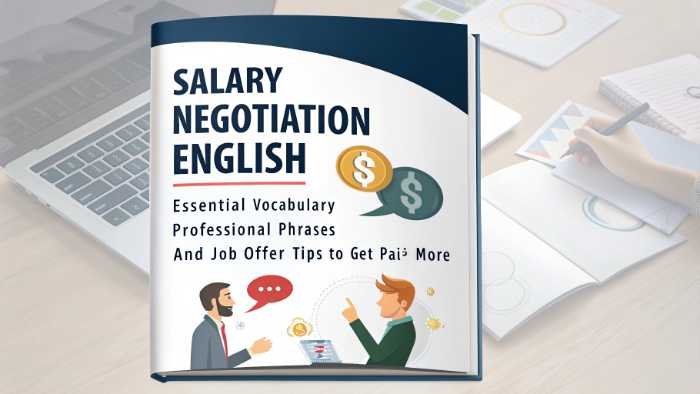
🧠 Test Your Salary Negotiation Skills
It’s time to test what you’ve learned! These quick quizzes will help you check your understanding of salary negotiation vocabulary and professional phrases used in real job situations.
💡 Choose the best answer and improve your confidence in professional communication and salary discussions.
💰 Salary Negotiation Quiz (Professional English)
Question 1
What does “salary” mean?
A) Money you earn from a job
✅ Correct Why: salary = income 💰B) A meeting
❌ Wrong Why: incorrect.C) A company
❌ Wrong Why: not correct.Question 2
Which sentence is more professional?
A) Give me more money
❌ Wrong Why: not professional.B) I would like to discuss my salary
✅ Correct Why: polite and professional.C) I want money
❌ Wrong Why: too direct.Question 3
What does “compensation package” include?
A) Salary and benefits
✅ Correct Why: full pay structure.B) Only salary
❌ Wrong Why: incomplete.C) Only bonus
❌ Wrong Why: not correct.Question 4
What is the purpose of salary negotiation?
A) To get better pay
✅ Correct Why: main goal 💰B) To quit a job
❌ Wrong Why: not correct.C) To avoid work
❌ Wrong Why: incorrect.Question 5
Which phrase shows flexibility?
A) I am open to negotiation
✅ Correct Why: shows willingness.B) I refuse
❌ Wrong Why: not flexible.C) No discussion
❌ Wrong Why: incorrect.Question 6
What does “job offer” mean?
A) A proposal from an employer
✅ Correct Why: correct meaning 💼B) A vacation
❌ Wrong Why: incorrect.C) A meeting
❌ Wrong Why: not correct.Question 7
Why is polite language important in salary discussions?
A) To sound professional
✅ Correct Why: important in business.B) To confuse people
❌ Wrong Why: opposite.C) To speak faster
❌ Wrong Why: incorrect.🧠 Advanced Salary Negotiation Quiz
Let’s go further! This advanced quiz will test your ability to understand professional salary negotiation phrases and use them correctly in real job situations.
💡 Focus on choosing the most professional and effective answer.
Question 1
Which sentence is best for salary negotiation?
A) I need more money
❌ Wrong Why: too direct.B) I would like to discuss my compensation
✅ Correct Why: professional tone 💼C) Pay me more
❌ Wrong Why: not professional.Question 2
What does “bonus” mean?
A) Extra money for performance
✅ Correct Why: correct meaning 💰B) A job title
❌ Wrong Why: incorrect.C) A meeting
❌ Wrong Why: not correct.Question 3
Which phrase shows confidence?
A) I believe my experience justifies a higher salary
✅ Correct Why: confident and professional.B) Maybe I deserve more
❌ Wrong Why: weak expression.C) I don’t know
❌ Wrong Why: not confident.Question 4
What does “benefits” refer to?
A) Extra advantages like insurance
✅ Correct Why: correct meaning.B) Only salary
❌ Wrong Why: incomplete.C) A company
❌ Wrong Why: incorrect.Question 5
Why is negotiation important?
A) To improve job offers and salary
✅ Correct Why: main goal 💰B) To avoid work
❌ Wrong Why: incorrect.C) To leave the job
❌ Wrong Why: not correct.🚀 Real-Life Salary Negotiation Scenarios
In this section, you will practice real-life situations that professionals face during salary discussions and job offers.
💡 Choose the most effective and professional response for each scenario.
Question 1
Your employer offers a lower salary than expected. What do you say?
A) This is too low
❌ Wrong Why: too direct.B) I would like to discuss the offer in more detail
✅ Correct Why: professional and polite.C) No, I refuse
❌ Wrong Why: not flexible.Question 2
You want to justify a higher salary. What do you say?
A) I need money
❌ Wrong Why: not professional.B) Based on my experience, I believe I deserve a higher salary
✅ Correct Why: strong and professional 💰C) Give me more
❌ Wrong Why: too direct.Question 3
You want to talk about benefits. What do you say?
A) Tell me everything
❌ Wrong Why: not professional.B) Could we discuss the benefits included in the offer?
✅ Correct Why: polite and professional.C) I don’t care
❌ Wrong Why: incorrect.Question 4
You want to show flexibility. What do you say?
A) I am open to negotiation
✅ Correct Why: shows flexibility.B) No discussion
❌ Wrong Why: not flexible.C) I refuse everything
❌ Wrong Why: incorrect.Question 5
You want to end the discussion professionally. What do you say?
A) Thanks
❌ Wrong Why: too basic.B) Thank you for your time, I look forward to your response
✅ Correct Why: professional closing.C) Bye
❌ Wrong Why: not professional.🎯 Great Job! You’re Improving Your Salary Negotiation Skills
By completing these quizzes, you’ve taken an important step toward mastering salary negotiation in English. Understanding vocabulary and using the right professional phrases can help you communicate more confidently in job discussions.
In real work situations, strong communication skills can make a big difference in job offers, career growth, and overall income 💰.
Keep practicing, improving your vocabulary, and applying these techniques — this is the key to getting better opportunities and higher salaries.
🚀 Next Step:
- ✔️ Practice salary negotiation daily
- ✔️ Use professional English in real job situations
- ✔️ Improve your communication with employers
- ✔️ Continue learning business English
💡 The more you practice, the more confident you become — and the closer you get to better job offers and higher income.
🧠 Free English Level Test
Check your English grammar and vocabulary level with this free online test.
Start the Level Test →🔥 English Grammar Quiz
Challenge yourself with this 60-question grammar quiz.
Take the Grammar Quiz →

My Grammar skills are growing on a daily basis and I’m super proud of my growth and development right now
My email, zabagodu@gmail.com
Thanks very much for learning me .
Thank you so much for devoted to sent us these topics sentence
Je suis intéressé
Thanks for the lesson about salary.
Ketolan98@gmail.com these education is better
I am understand your education thank you my mom/ dad thank you