
“Essential Business English Vocabulary and Grammar for High-Paying Jobs (With Examples)”
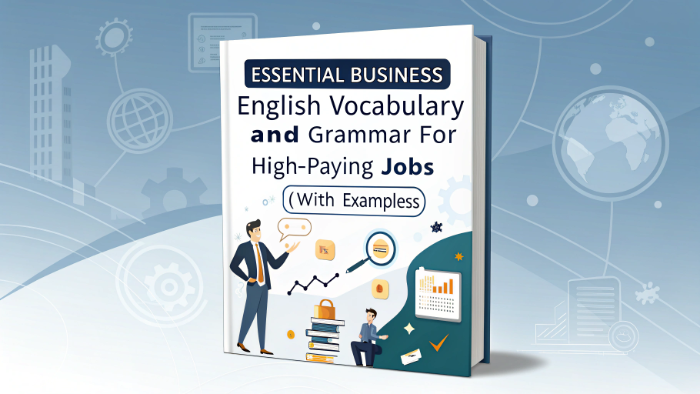
Do you know English vocabulary but still struggle to use it correctly in real work situations? 🤔
Many learners understand words, but they find it difficult to build correct sentences — especially in professional environments.
In today’s competitive job market 💼, knowing the right vocabulary is not enough. Employers expect you to use proper grammar and communicate clearly in emails, meetings, and daily work conversations.
That’s why in this guide, you will learn essential business English vocabulary combined with practical grammar rules 🧠 — so you can understand, build, and use correct sentences with confidence.
Whether you want to get a better job, work with international clients, or increase your salary 💰, mastering both vocabulary and grammar is the key to professional success.
🚀 By the end of this guide, you will be able to use English more naturally in real business situations and improve your career opportunities.
💼 Essential Business English Vocabulary for Work and Career Growth
To succeed in professional environments, you need to understand and use common business English words. These words are frequently used in job interviews, emails, meetings, and daily work communication.
| 💼 Word | 📌 Meaning | 🧾 Example |
|---|---|---|
| 💰 Salary | The money you earn from a job | I am looking for a higher salary. |
| 🤝 Client | A person or company you work with | We have many international clients. |
| 📊 Project | A piece of work with a goal | I am working on a new project. |
| 📈 Performance | How well you do your job | My performance improved this year. |
| 🚀 Career | Your professional journey | I want to grow in my career. |
| 📧 Communication | Exchanging information | Good communication is important at work. |
| 💡 Opportunity | A chance to succeed | This job is a great opportunity. |
💡 Learning these words will help you communicate more effectively and increase your chances of success in professional environments.
🧠 Business English Grammar for Work Communication
Understanding grammar is essential if you want to use English correctly in professional environments. In business communication, even small grammar mistakes can affect how others see your professionalism.
One of the most important grammar structures used at work is the Present Simple, which is used to talk about daily tasks, responsibilities, and regular actions.
Subject + base verb (I work, You send, They manage)
He/She/It + verb + s (He works, She writes, It helps)
| 🧩 Subject | 💼 Example Sentence | 📌 Use in Work |
|---|---|---|
| I | I work with international clients. | Daily job tasks |
| She | She manages a marketing project. | Describing responsibilities |
| They | They send emails to clients. | Team actions |
| He | He works in a corporate company. | Job description |
💡 Using correct grammar helps you sound more professional, especially when writing emails or communicating with clients and colleagues.
🔥 Use Business Vocabulary and Grammar in Real Sentences
Now that you’ve learned important business vocabulary and grammar rules, it’s time to combine them in real sentences. This will help you understand how English is actually used in professional situations.
I work with international clients and manage important projects.
| 🧩 Word | 📌 Role | 💡 Explanation |
|---|---|---|
| I | Subject | The person speaking |
| work | Verb (Present Simple) | Describes a daily action |
| with | Preposition | Shows connection |
| international clients | Object | People you work with |
| and | Connector | Links ideas |
| manage | Verb | Describes responsibility |
| important projects | Object | Work tasks |
She works in a corporate company and communicates with clients daily.
| Word | Role | Explanation |
|---|---|---|
| She | Subject | Third person |
| works | Verb (+s) | Present Simple rule |
| in a corporate company | Context | Work environment |
| communicates | Verb | Daily action |
| with clients | Object | Professional interaction |
| daily | Adverb | Frequency |
💡 By combining vocabulary and grammar in real sentences, you can improve your communication skills and sound more professional in business environments.
🧠 Business English Quiz (Vocabulary + Grammar)
Question 1
Which sentence is correct in Present Simple?
A) She work with clients
❌ Wrong Why: missing “s” for third person.B) She works with clients
✅ Correct Why: correct grammar rule (he/she/it + verb + s).C) She working with clients
❌ Wrong Why: wrong tense.Question 2
What does “client” mean?
A) A person you work with professionally
✅ Correct Why: correct meaning.B) A place
❌ Wrong Why: not correct.C) A verb
❌ Wrong Why: incorrect.Question 3
What is the role of “work” in the sentence: “I work with clients”?
A) Subject
❌ Wrong Why: subject is “I”.B) Verb
✅ Correct Why: it describes the action.C) Object
❌ Wrong Why: not receiving action.Question 4
Which word is a business-related word?
A) Salary
✅ Correct Why: related to work and income.B) Apple
❌ Wrong Why: not business context.C) Sleep
❌ Wrong Why: not related.Question 5
Which sentence is more professional?
A) I want a better salary
❌ Wrong Why: too direct.B) I would like a higher salary
✅ Correct Why: more polite and professional.C) Give me more money
❌ Wrong Why: not professional.Question 6
What does “career” mean?
A) Your professional journey
✅ Correct Why: correct meaning.B) A place
❌ Wrong Why: incorrect.C) A tool
❌ Wrong Why: not correct.Question 7
Why is grammar important in business English?


Good question to understand about a business april 8,2026
Gaining some knowledge in English Business
Good question and good understand
𝚂𝚒𝚖𝚙𝚎 𝚚𝚞𝚎𝚜𝚝𝚒𝚘𝚗𝚜 𝚊𝚗𝚍 𝚟𝚎𝚛𝚢 𝚞𝚗𝚍𝚎𝚛𝚜𝚝𝚊𝚗𝚍𝚊𝚋𝚕𝚎
Thank you for this question about business i learn faster like this situation of sentences
A fun way of learning English language to communicate with confidence in the workplace.
Hi very helpfull
Very helpful
It’s very helpful. Thank you 🙏 so much
I am elated to answer your exam Correctly.
Thank you so much I really appreciate it
Thanks