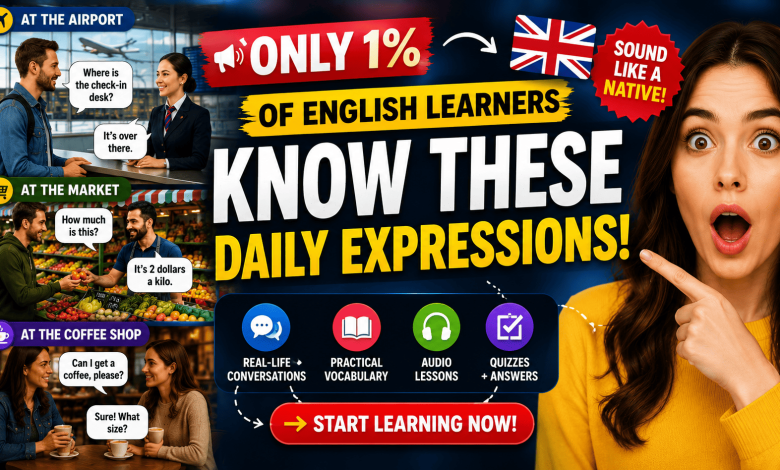
Only 1% of English Learners Know These Daily Expressions
🧠 Part 2: Test Your Daily English Expressions
Welcome to Part 2! By now, you’ve learned some of the most common English expressions used by native speakers in everyday conversations. The next step is to practice and remember them through interactive quizzes and real-life examples.
These quizzes are designed to improve your English vocabulary, strengthen your English speaking skills, and help you understand how native speakers use these expressions naturally. Read each question carefully, learn from the explanations, and don’t worry if you make mistakes—every answer is a chance to improve.
🎯 In Part 2, you will:
✅ Test your knowledge with interactive quizzes.
✅ Learn new daily English expressions.
✅ Improve your speaking and listening skills.
✅ Build confidence for real-life conversations.
🧠 Daily English Expressions Quiz (With Explanations)
Question 1
If someone says “How’s it going?”, they are asking…
A) How are you?
✅ CorrectThis is a very common greeting used in everyday English.
B) Where are you going?
❌ WrongC) What time is it?
❌ WrongQuestion 2
What does “No worries” mean?
A) It’s okay
✅ CorrectNative speakers often say “No worries” instead of “You’re welcome” or “It’s okay.”
B) I’m worried
❌ WrongC) Be careful
❌ WrongQuestion 3
If your friend says “Sounds good!”, they…
A) Agree with the idea
✅ Correct“Sounds good!” means “I like that idea.”
B) Don’t understand
❌ WrongC) Want to leave
❌ WrongQuestion 4
What does “Hang on” mean?
A) Wait a moment
✅ CorrectPeople use “Hang on” when asking someone to wait.
B) Sit down
❌ WrongC) Hurry up
❌ WrongQuestion 5
If someone says “I’m starving”, they mean…
A) They are very hungry
✅ Correct“I’m starving” is a common way to say you’re extremely hungry.
B) They are tired
❌ WrongC) They are sick
❌ WrongQuestion 6
What does “Keep it up!” mean?
A) Continue doing well
✅ CorrectPeople use this expression to encourage someone.
B) Stop working
❌ WrongC) Go home
❌ WrongQuestion 7
When someone says “It’s up to you”, they mean…
A) You decide
✅ CorrectThe other person is letting you make the decision.
B) It’s impossible
❌ WrongC) Hurry up
❌ WrongQuestion 8
What does “I can’t wait!” mean?
A) I’m very excited
✅ CorrectIt shows excitement about something in the future.
B) I’m tired
❌ WrongC) I’m leaving
❌ WrongQuestion 9
If someone gives you something, they may say…
A) Here you go.
✅ CorrectThis expression is used when handing something to another person.
B) See you around.
❌ WrongC) Good point.
❌ WrongQuestion 10
Which expression is used to congratulate someone?
A) That’s awesome!
✅ CorrectNative speakers often say “That’s awesome!” when they hear good news.
B) Hang on.
❌ WrongC) Take your time.
❌ Wrong📚 Learn These Expressions Before the Next Quiz
Take a few minutes to study these everyday English expressions. They are frequently used by native speakers and will help you answer the next quiz more confidently.
| 💬 Expression | 📖 Meaning | 💡 Example |
|---|---|---|
| 🤞 Fingers crossed! | I hope everything goes well. | Fingers crossed! I hope I pass the exam. |
| ⏰ Better late than never. | It’s better to do something late than not at all. | I finally started learning English. Better late than never! |
| 💪 Never give up. | Don’t stop trying. | Never give up on your dreams. |
| 🚀 Go for it! | Do it with confidence. | You want the job? Go for it! |
| 🎉 Well done! | You did a good job. | Well done! Your English is improving. |
| 🤔 Let me think. | Give me a moment to decide. | Let me think before I answer. |
| 😊 No problem. | It’s okay. | No problem. I’m happy to help. |
| 📞 Stay in touch. | Keep communicating. | Stay in touch after your trip. |
| ⭐ Good job! | You did very well. | Good job! Keep practicing. |
| 🙌 You’re doing great! | You are making excellent progress. | You’re doing great. Keep learning every day. |
🧠 Quick Tip: Read each expression aloud, repeat it three times, and try to create your own sentence before taking the next quiz.
🏆 Daily English Expressions Quiz 2 (With Explanations)
Question 1
What does “Fingers crossed!” mean?
A) I hope everything goes well.
✅ CorrectPeople say this when they hope for a good result.
B) Be careful.
❌ WrongC) Shake hands.
❌ WrongQuestion 2
“Better late than never” means…
A) It’s better to do something late than not at all.
✅ CorrectThis expression encourages people to start, even if it’s late.
B) Always arrive late.
❌ WrongC) Never be late.
❌ WrongQuestion 3
What does “Never give up” mean?
A) Keep trying.
✅ CorrectIt encourages you to continue working toward your goal.
B) Stop immediately.
❌ WrongC) Take a vacation.
❌ WrongQuestion 4
If someone says “Go for it!”, they mean…
A) Do it with confidence.
✅ CorrectIt’s a way to encourage someone to take action.
B) Leave now.
❌ WrongC) Wait longer.
❌ WrongQuestion 5
When someone says “Well done!”, they are…
A) Praising you.
✅ CorrectPeople use this expression after a good performance.
B) Asking a question.
❌ WrongC) Saying goodbye.
❌ WrongQuestion 6
What does “Let me think.” mean?
A) Give me a moment to decide.
✅ CorrectIt’s used when you need time before answering.
B) I know the answer.
❌ WrongC) I’m leaving.
❌ WrongQuestion 7
What does “No problem.” mean?
A) It’s okay.
✅ CorrectIt’s a friendly reply after helping someone.
B) I have a problem.
❌ WrongC) I’m busy.
❌ WrongQuestion 8
If someone says “Stay in touch.”, they mean…
A) Keep communicating.
✅ CorrectFriends often say this before saying goodbye.
B) Don’t call me.
❌ WrongC) Go home now.
❌ WrongQuestion 9
When do people usually say “Good job!”?
A) After someone does something well.
✅ CorrectIt’s used to congratulate or encourage someone.
B) Before going to bed.
❌ WrongC) When ordering food.
❌ WrongQuestion 10
What does “You’re doing great!” mean?
A) You are making excellent progress.
✅ CorrectThis expression motivates someone to keep going.
B) You should stop.
❌ WrongC) You made a mistake.
❌ Wrong📚 Learn These Daily Expressions Before Quiz 3
Take a few minutes to study these useful English expressions. They are very common in everyday conversations and will help you answer the next quiz with confidence.
| 💬 Expression | 📖 Meaning | 💡 Example |
|---|---|---|
| ☕ Help yourself. | Take what you want. | Help yourself to some coffee. |
| 🎉 That’s perfect! | Exactly what I wanted. | Your answer is perfect! |
| 😅 My mistake. | I made an error. | Sorry, my mistake. |
| 💯 Exactly! | You are completely right. | Exactly! That’s the correct answer. |
| 🤷 I have no idea. | I don’t know. | I have no idea where he is. |
| 👏 Nice work! | You did a great job. | Nice work on your English test. |
| 🚶 Follow me. | Come with me. | Follow me to the meeting room. |
| 🎯 That’s right. | Correct. | That’s right! Well done. |
| ⌛ One moment, please. | Please wait a short time. | One moment, please. I’ll check. |
| 🌟 Keep going! | Don’t stop. | Keep going! You’re improving every day. |
🧠 Study Tip: Read every expression aloud, repeat it three times, and create your own example before starting Quiz 3. This simple habit will help you remember the expressions much faster.
🎯 Daily English Expressions Quiz 3 (With Explanations)
Question 1
What does “Help yourself.” mean?
A) Take what you want.
✅ CorrectPeople often say this when offering food or drinks.
B) Leave immediately.
❌ WrongC) Help another person.
❌ WrongQuestion 2
When someone says “That’s perfect!”, they mean…
A) Exactly what I wanted.
✅ CorrectThis expression shows strong satisfaction.
B) It’s terrible.
❌ WrongC) It’s impossible.
❌ WrongQuestion 3
If you say “My mistake.”, you are…
A) Admitting you made an error.
✅ CorrectIt’s a polite way to apologize for a mistake.
B) Asking for directions.
❌ WrongC) Saying hello.
❌ WrongQuestion 4
What does “Exactly!” mean?
A) You are completely right.
✅ CorrectNative speakers use it to agree strongly.
B) I don’t know.
❌ WrongC) Maybe later.
❌ WrongQuestion 5
If someone says “I have no idea.”, they mean…
A) I don’t know.
✅ CorrectThis is a very common everyday expression.
B) I know everything.
❌ WrongC) I’m ready.
❌ WrongQuestion 6
When someone says “Nice work!”, they are…
A) Complimenting you.
✅ CorrectIt means you did something well.
B) Asking for help.
❌ WrongC) Saying goodbye.
❌ WrongQuestion 7
What does “Follow me.” mean?
A) Come with me.
✅ CorrectPeople use this when showing someone the way.
B) Wait here.
❌ WrongC) Sit down.
❌ WrongQuestion 8
If your teacher says “That’s right.”, it means…
A) Your answer is correct.
✅ CorrectTeachers often use this to confirm a correct answer.
B) You’re late.
❌ WrongC) Try again.
❌ WrongQuestion 9
What does “One moment, please.” mean?
A) Please wait a short time.
✅ CorrectYou’ll often hear this in shops, hotels, and offices.
B) Leave now.
❌ WrongC) Come tomorrow.
❌ WrongQuestion 10
What does “Keep going!” mean?
A) Don’t stop.
✅ CorrectThis expression encourages someone to continue.
B) Turn around.
❌ WrongC) Go home.
❌ Wrong🎯 Summary & Final Thoughts
Congratulations! 🎉 You’ve completed this lesson and learned many useful daily English expressions, practical conversations, real-life vocabulary, and interactive quizzes that native English speakers use every day.
Remember that fluency comes from daily practice, not from memorizing hundreds of grammar rules. The more you listen, speak, read, and repeat these expressions, the more natural your English will become.
Don’t worry if you can’t remember everything today. Review these expressions regularly, practice the conversations with the audio, and complete the quizzes again. Every time you practice, you’ll become more confident and improve your English little by little.
🌟 What You Learned
✅ Daily English Expressions Used by Native Speakers
💬 Real-Life English Conversations
🎧 Audio Listening Practice
📚 Practical Vocabulary for Everyday Situations
🧠 Interactive Quizzes with Explanations
🗣️ Speaking Practice to Build Confidence
🚀 Keep Improving Every Day
Learning English is a journey, and every new word, conversation, and quiz brings you one step closer to speaking with confidence. Keep practicing every day, stay consistent, and never stop learning. Your future self will thank you!
🚀 Continue Your English Journey
Don’t stop here! Explore more free English lessons, practice with audio, improve your vocabulary, and become a more confident English speaker.
🌟 Practice every day. Learn something new every day. Speak English with confidence.